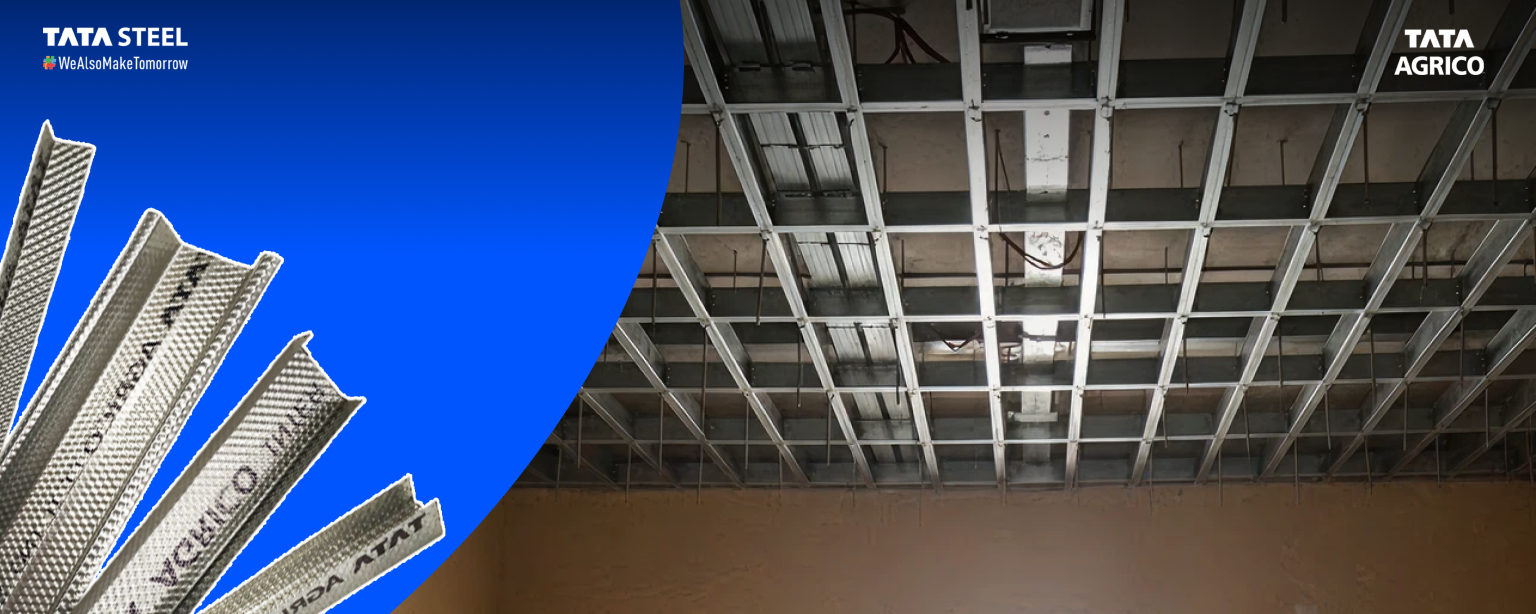


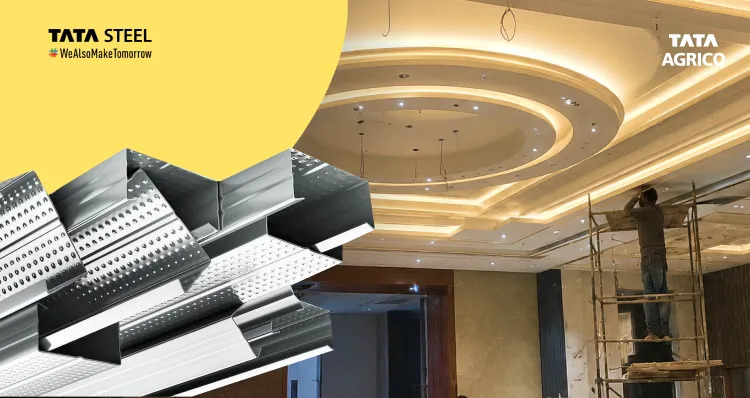


A false ceiling can completely change how a room looks and feels. But behind that smooth surface is a metal grid doing all the heavy lifting. Get the framework wrong, and cracks show up, panels sag, and edges come apart.
Most false ceiling problems trace back to one thing: using the wrong channels or installing them carelessly. This guide covers the four channel types that make up a false ceiling system, what each does, and how to put them together right.
Achieving a Crack-Free False Ceiling Finish
A crack-free false ceiling installation depends on how well the framework handles movement, load, and alignment over time. Even high-quality panels can develop visible joint cracks if the supporting grid is uneven or flexible. Properly installed perimeter channels, combined with the right channel thickness and fixing intervals, help maintain a stable framework that keeps panel edges aligned and reduces stress at the joints. That stability ensures a cleaner finish and longer-lasting ceiling performance.
The Four Channels You Need
1. Ceiling Section (Main Runner)
This is the backbone of the grid. It runs across the room, suspended from the slab above using hanger wires, and everything else in the framework attaches to it.
Tata Agrico Ceiling Section: 72mm x 25mm x 43mm, available in 0.35mm and 0.40mm thickness, with 80 GSM galvanized zinc coating for rust resistance.
Fix at 1200mm intervals across the span. The deeper profile handles the load without bowing, keeping the surface flat over time.
2. Perimeter Channel (Wall Track)
This is where the installation begins and where most problems start if it is done wrong.
The perimeter channel fixes to the wall on all four sides of the room. It sets the finished ceiling height and acts as the reference level for the entire grid. Panels rest on it at the edges. Everything takes its level from it.
Tata Agrico Perimeter Channels: 20mm x 27mm x 30mm, in 0.35mm and 0.40mm thickness, with 80 GSM galvanized zinc coating. These are high-strength perimeter channels precision-engineered to maintain alignment across the full perimeter, which is exactly what prevents edge cracks.
Use a laser level and fix at 300–400mm intervals. A channel that runs even slightly off-level will cause panel edges to sit unevenly, and those joints will crack with time. These crack-resistant perimeter channels are built for both residential and commercial false ceiling perimeter channel systems.
3. Intermediate Channel (Cross Channel)
Intermediate channels slot between the main runners, perpendicular to them, completing the grid that panels lie on. They are lighter than the ceiling section but directly responsible for keeping the surface flat.
Tata Agrico Intermediate Channel: 15mm x 45mm x 15mm, in 0.40mm and 0.50mm thickness with 80 GSM galvanized zinc coating.
Space at 400–600mm depending on panel size. Stretch a string line from the perimeter channel on one wall to the other. Every intermediate channel should sit at that exact level before you fix panels.
4. Ceiling Angle (Edge Trim)
The ceiling angle goes on last. It covers the joint where the panel edge meets the wall, gives the ceiling a clean border, and reinforces the wall-ceiling junction.
Tata Agrico Ceiling Angle: 20mm x 20mm, 0.35mm and 0.40mm thickness with 80 GSM galvanized zinc coating. Light, easy to fix, and holds paint well.
How They Come Together
- Mark the ceiling height on all walls with a laser level.
- Fix the perimeter channel along all four walls at that height.
- Suspend ceiling sections from the slab at 1200mm intervals.
- Clip in intermediate channels between the runners at 400–600mm.
- Lay panels into the grid, resting on the perimeter channel at the edges.
- Fix ceiling angle over the wall-ceiling joint to finish.
That is the full ceiling perimeter framework working as it should.
Which Thickness to Choose
0.35mm suits standard home ceilings with shorter spans and lighter panels.
0.40mm is right for commercial spaces, longer spans, heavier panels, or high-traffic areas.
The weight difference is small. The performance difference over years is not.
Common Mistakes to Avoid
Skipping the level check on the perimeter channel. Every other step references this. A few millimetres off here becomes a visible crack later.
Spacing fixings too far apart. The perimeter channel must be firmly fixed throughout. Gaps in fixing points let it flex under load.
Using 0.35mm where 0.40mm is needed. That flex in the grid is how joints crack over time.
Getting It Right from the Start
Modern false ceiling perimeter solutions are designed for faster installation and cleaner finishes. But no surface treatment covers a poorly built grid. Cracks come back, panels shift, and the ceiling needs work again far sooner than it should.
Tata Agrico is a trusted perimeter channel manufacturer in India, offering durable false ceiling perimeter channels with 80 GSM galvanized coating built for long-term performance. The full range covers perimeter channels for false ceiling across residential and commercial applications.
To buy perimeter channels online or check Tata Agrico perimeter channels price in India, visit the product page below.